

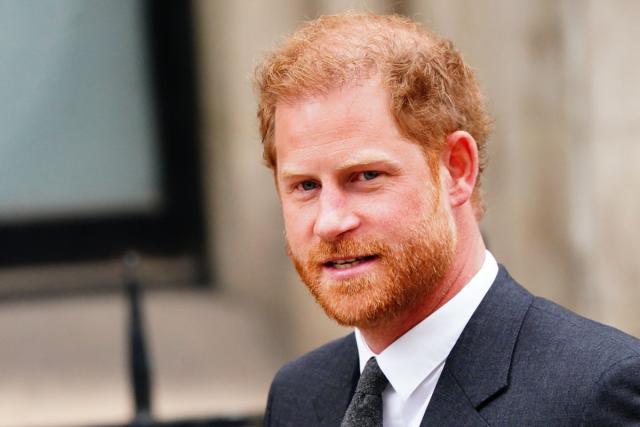

Next Tuesday, June 6, the US government will appear in federal court to answer questions about Prince Harry’s visa application after he admitted to using illegal narcotics.
The Heritage Foundation, a conservative think tank based in Washington, DC, is suing Joe Biden’s government to force officials to divulge the Duke of Sussex’s immigration records.
The organisation wants to investigate how the prince got into the country after admitting in his explosive biography Spare to using cocaine, cannabis, and magic mushrooms.
The Heritage Foundation has announced that its case will be heard by a federal judge on June 6 at 2.30 p.m. in courtroom 17 of the United States District Court for the District of Columbia.
The US government will testify in court on Prince Harry.
Nile Gardner, director of the Margaret Thatcher Centre for Freedom at the Heritage Foundation, announced the announcement, adding that it would be available to the press.
A decision to release immigration data could have ramifications for Harry’s standing in the US, as admitting to drug usage can result in a visa application being denied.
The Heritage Foundation wants to know if the duke’s drug revelations in Spare were revealed in his immigration application.
The group filed the court appeal after the application to make the application public in an accelerated manner under the Freedom of Information Act was denied in March.
Harry reveals in his autobiography Spare that he first tried cocaine at the age of 17 on a shooting weekend. He performed a ‘few more lines’ on subsequent occasions.
He also admitted to hallucinating at a celebrity-studded event in California and smoking marijuana following his first date with Meghan.
And the Duke spoke of his ‘good’ encounter with the psychedelic substance ayahuasca, claiming it ‘gave me a sense of relaxation, release, comfort, a lightness that I managed to hold on to for a length of time’.
Harry made the remarks during an interview with therapist Dr. Gabor Maté, an outspoken supporter of drug decriminalisation who has supposedly employed the Amazonian plant ayahuasca to treat patients with psychiatric illnesses.
‘(Cocaine) didn’t do much for me, it was more of a social thing and provided me a sense of belonging, I believe it probably also made me feel different to how I was feeling, which was sort of the objective,’ Harry said.
‘Marijuana is different; it truly helped me.’
Under US law, anyone who admits to having abused illegal substances in the past is generally barred from entering the nation.
Applicants for a visa to live and work in the United States must select a box to answer ‘yes’ or ‘no’ to a question about previous drug use. ‘Are you or have you ever been a drug abuser or addict?’ it asks.
Answering yes can result in denial of a US visa, as Amy Winehouse experienced in 2008, forcing her to abandon plans to attend the Grammy Awards.
However, admitting to drug usage does not inevitably result in a lifetime ban from the United States. Any entry denial can be reversed following an in-person interview at a US consulate or official immigration office, where a waiver can be obtained.
According to the Heritage Foundation, there is ‘immense public interest’ in discovering how Harry answered the drug issue in his application.
And, given the history of authorities revealing immigration data pertaining to public figures, they will no doubt be optimistic about their chances of success.
The website of the US Citizenship and Immigration Services provides an electronic reading room with files from celebrities such as the late performers George Michael and John Lennon.